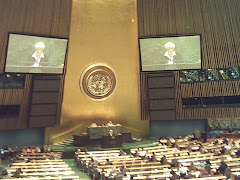
Congratulations to Rotary International for their work with children of the 3rd world.."Life of a Child". Last week there was a day devoted to diabetes at the UN and the work of Rotary was applauded, and case studies were shown on film where they provided free insulin to children who often has to walk 4/6 hours to get their medicine,congrats. to you all members of Rotary.
We often hear the word KINDNESS mentioned... it is heard by the deaf and seen by the blind.
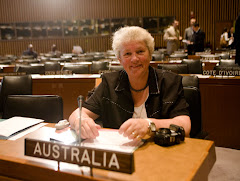
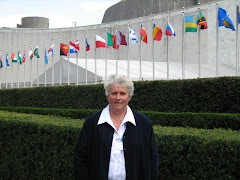
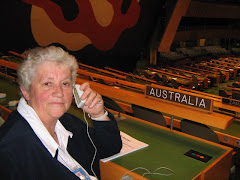
I am now at the half way mark of my tenure here at the UN, and I want to take the opportunity to let the Australian people know how well they are represented here at the Australian Mission for the UN. Whilst Aust. may be seen as a small player on the world stage .. we are a much respected and credible country, made so by the dedicated staff at the mission led by the Hon. Robert Hill.. a minister of the former gov.
The highlight of my past week has been the work done with children of the 3rd world especially "children soldiers in conflict"
It is difficult for us in Aust. to comprehend that in neighbouring countries there are children being abducted abused and forced to fight in the wars of that country. On the other hand there are children and families who actually join their children up as soldiers to escape the poverty they are living in.
To Illaroo Public SChool, you deserve special praise for the work you are doing with children 0f 3rd world countries, you quickly took up the challenge when I contacted your school, and now the UN will be sending you special material so you can continue to do even more.. we are very proud of you all.
Finally, to a city that never sleeps... even the energy crises has hit New York, finally they are starting to turn out the lights at night as notices have gone out to all who live here asking for co operation to do so. Makes sense as for a briefing I attended on the outcome of the G20,, where it was a full house, asking for all countries to include their local citizens.
Wednesday, November 19, 2008

Tuesday, November 4, 2008
Gilmore Youth Leadership Forum 2008
Just a quick word of thanks to everyone who particpated in this year's Gilmore Youth Leadership Forum.
It was a one event I did not want to miss but I have had some great feedback and the pictures are great.
I, particualrly, want to thank all the stduents who took part. It is an event that crosses the age barrier but at its heart are the young people of our community and without their support and keen participation it would not exist.
This year's event was again at the Waterslea Conference Centre, which really is one of the jewels in our region's crown. I encourage everyone who has not seen the facility at West Cambewarra to take some time and do so, it is a beautiful facility.
Thanks again to our speakers: Shanaka Fernando, Don Woodland, Tania Hayes, Paula Smith, Mark Ettridge and Anthony Bonnici and to all the leaders, all volunteers, all the sponsors and all the Waterslea staff who assisted.
Again, I thanks to Andrew Guile from the Nowra Anglican College for volunteering his time to run the program.
It was a one event I did not want to miss but I have had some great feedback and the pictures are great.
I, particualrly, want to thank all the stduents who took part. It is an event that crosses the age barrier but at its heart are the young people of our community and without their support and keen participation it would not exist.
This year's event was again at the Waterslea Conference Centre, which really is one of the jewels in our region's crown. I encourage everyone who has not seen the facility at West Cambewarra to take some time and do so, it is a beautiful facility.
Thanks again to our speakers: Shanaka Fernando, Don Woodland, Tania Hayes, Paula Smith, Mark Ettridge and Anthony Bonnici and to all the leaders, all volunteers, all the sponsors and all the Waterslea staff who assisted.
Again, I thanks to Andrew Guile from the Nowra Anglican College for volunteering his time to run the program.
Monday, November 3, 2008
More from the UN
Things have certainly started to move at the UN, with a lot of committees now finalizing some of their work programmes.
I felt very priviledged to observe a full morning round table with high profile delegates from Russia, China,India Pakistan and the USA. Henry Kissinger was the guest speaker and MC. Must admit it is a bit scary when you hear them speak about the issue of consensus on eliminating WMD and disarmament. As always the Question is who goes first...
This week will see the vote take place at the UN for candidates for the 14 places on the International Committee for the Disabled for the UN.
There are 22 candidates and Austalia is one of them. With the lobbying done to date with the some 44 member countries I do believe that our Prof. McCallum has a good 50/50 chance. Listening to some of the speakers last week, I thought the phrase "Nothing about us.. Without us"
was very apt. Must say it was somewhat disapointing to see that with all the people with disabilities present on the day, that there was really only one room that could take them.
The news in the papers over here has certainly been the number of job losses not just in the financial sector but now also hitting the restaurant, catering and hospitality sections, in fact this news has somewhat overshadowed the coming election for President.
On personal note I took my first train ride last week... and my last, as one who does not like small confined spaces , it totally freaked me out, as people were literally being pushed into the train to make use of every bit of the standing space. Back to the buses and walking for me.
Have been invited to go to the Fireman,s bakeoff at Ground Zero this week ... so it is not only the Milton Ulladulla Show that has bakeoffs. Will try to compare them
Have just arrived home from another Sunday at the soup kitchen, was able to speak to some of the regulars there, as they are starting to know me now. Some of them have some very interesting and sad backgrounds.
I felt very priviledged to observe a full morning round table with high profile delegates from Russia, China,India Pakistan and the USA. Henry Kissinger was the guest speaker and MC. Must admit it is a bit scary when you hear them speak about the issue of consensus on eliminating WMD and disarmament. As always the Question is who goes first...
This week will see the vote take place at the UN for candidates for the 14 places on the International Committee for the Disabled for the UN.
There are 22 candidates and Austalia is one of them. With the lobbying done to date with the some 44 member countries I do believe that our Prof. McCallum has a good 50/50 chance. Listening to some of the speakers last week, I thought the phrase "Nothing about us.. Without us"
was very apt. Must say it was somewhat disapointing to see that with all the people with disabilities present on the day, that there was really only one room that could take them.
The news in the papers over here has certainly been the number of job losses not just in the financial sector but now also hitting the restaurant, catering and hospitality sections, in fact this news has somewhat overshadowed the coming election for President.
On personal note I took my first train ride last week... and my last, as one who does not like small confined spaces , it totally freaked me out, as people were literally being pushed into the train to make use of every bit of the standing space. Back to the buses and walking for me.
Have been invited to go to the Fireman,s bakeoff at Ground Zero this week ... so it is not only the Milton Ulladulla Show that has bakeoffs. Will try to compare them
Have just arrived home from another Sunday at the soup kitchen, was able to speak to some of the regulars there, as they are starting to know me now. Some of them have some very interesting and sad backgrounds.
Tuesday, October 21, 2008
United Nations presentation, October 17, 2008
Sixty-third General Assembly
First Committee
11th Meeting (PM)
FIGHTING BIOLOGICAL WARFARE TURNS CORNER AS BIOLOGICAL WEAPONS CONVENTION EDGES
CLOSER TO UNIVERSALIZATION, FIRST COMMITTEE HEARS IN THEMATIC DEBATE
Potential of Missiles to Deliver Payload of Mass Destruction Weapons Quickly,
Accurately Makes Them Major Political, Military Issue; Three Related Drafts Tabled
JOANNA GASH ( Australia ), chair of the Australia Group which works with 40 other countries and the European Commission in strengthening chemical and biological export control lists, said that the Chemical Weapons Convention had emerged as a cornerstone of the multilateral non-proliferation and disarmament architecture.
It was crucial to efforts to halt the proliferation of chemical weapons. Australia was encouraged by continuing progress in the destruction of chemical weapons, which had resulted in the verified elimination of more than one third of declared stockpiles. One former possessor State had completed elimination of all chemical weapons. She urged the other five possessor States to make every effort to meet their extended deadlines for destruction.
At the same time, she regretted that the Second Review Conference of the Chemical Weapons Convention in May had experienced a difficult negotiating environment, which had prevented constructive discussion of many of the challenges facing the treaty and, thus, agreement by States parties on how to deal with them.
It was now vital that all of them look to the future to ensure that that Convention adapted to developments in science and technology. “We must continue to strive for the full and effective implementation of declaration and inspection requirements to activities not prohibited by the Convention”, she urged.
Asserting that the Biological Weapons Convention was strengthening global defences against biological weapons and bioterrorism, she noted the strides made by the Convention, with an increase from 155 to 162 State parties with an additional 13 signatories.
She congratulated the three States that had acceded to the Convention this year -- Zambia, Madagascar and the United Arab Emirates.
Despite those monumental steps, more needed to be done to counter weapons of mass destruction delivery systems, especially absent an international treaty covering ballistic missile proliferation.
Australia and the Republic of Korea would submit a resolution on the prevention of illicit brokering -- black market activity -- by which the perpetrators sought to avoid the restrictions set out in the Biological and Chemical Weapons Conventions and the export control regimes.
First Committee
11th Meeting (PM)
FIGHTING BIOLOGICAL WARFARE TURNS CORNER AS BIOLOGICAL WEAPONS CONVENTION EDGES
CLOSER TO UNIVERSALIZATION, FIRST COMMITTEE HEARS IN THEMATIC DEBATE
Potential of Missiles to Deliver Payload of Mass Destruction Weapons Quickly,
Accurately Makes Them Major Political, Military Issue; Three Related Drafts Tabled
JOANNA GASH ( Australia ), chair of the Australia Group which works with 40 other countries and the European Commission in strengthening chemical and biological export control lists, said that the Chemical Weapons Convention had emerged as a cornerstone of the multilateral non-proliferation and disarmament architecture.
It was crucial to efforts to halt the proliferation of chemical weapons. Australia was encouraged by continuing progress in the destruction of chemical weapons, which had resulted in the verified elimination of more than one third of declared stockpiles. One former possessor State had completed elimination of all chemical weapons. She urged the other five possessor States to make every effort to meet their extended deadlines for destruction.
At the same time, she regretted that the Second Review Conference of the Chemical Weapons Convention in May had experienced a difficult negotiating environment, which had prevented constructive discussion of many of the challenges facing the treaty and, thus, agreement by States parties on how to deal with them.
It was now vital that all of them look to the future to ensure that that Convention adapted to developments in science and technology. “We must continue to strive for the full and effective implementation of declaration and inspection requirements to activities not prohibited by the Convention”, she urged.
Asserting that the Biological Weapons Convention was strengthening global defences against biological weapons and bioterrorism, she noted the strides made by the Convention, with an increase from 155 to 162 State parties with an additional 13 signatories.
She congratulated the three States that had acceded to the Convention this year -- Zambia, Madagascar and the United Arab Emirates.
Despite those monumental steps, more needed to be done to counter weapons of mass destruction delivery systems, especially absent an international treaty covering ballistic missile proliferation.
Australia and the Republic of Korea would submit a resolution on the prevention of illicit brokering -- black market activity -- by which the perpetrators sought to avoid the restrictions set out in the Biological and Chemical Weapons Conventions and the export control regimes.
Monday, October 20, 2008
You never know what to expect at the UN
What I thought was to be a relelatively quiet week at the UN turned out to have some very interesting meetings, and one that allowed me to make another speech in regards to Weapons of Mass Destruction and the elimination of same.
The General Assembly also voted on fiveextra countries to represent the security council, Australia will be applying for a place in 2013.
Was priviledged to sit in on a youth meeting organised by Holland and Australia. We often hear about the negative stories about our young people, well I need to say how proud I was of all the delegates from about 20 different countries who took part. It is a pity that we pollies don,t get to hear of these types of discussions. The average age of the delegates were 17-22, so as I said I felt very honoured to have been asked to attend.
On the weekend I made another trip to ground zero to get a closer look at the new "Freedom Tower" being built to replace the Twin Towers. I still find it hard to comprehend the enormity of it all. There are still some buildings near it that have still not been re occupied. Whilst there I went to Wall Street, heart of the finance sector. People are still wandering around shaking their heads asking "How did this all happen"
My Labor collegue and I invited some of the interns at the Aust. mission over for dinner. Again these young adults have travelled far and wide, some as volunteers, all in order to advance and increase their job prospects and to gain knowledge from aound the world.
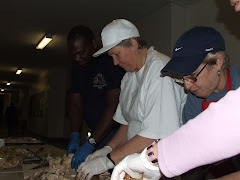
Today Sunday. I have just returned from volunteering at a "soup kitchen" in near the Harlem area, run by St.Johns Church of the Divine, don't think I have ever cut up as much fruit salad ... and my dishwashing skills are still there from my hospitality days. It certainly brought home to other side of New York.
I am still finding that walking is much quicker than the bus, and I really do enjoy seeing the people and trying to guess what and where they might work.
The General Assembly also voted on fiveextra countries to represent the security council, Australia will be applying for a place in 2013.
Was priviledged to sit in on a youth meeting organised by Holland and Australia. We often hear about the negative stories about our young people, well I need to say how proud I was of all the delegates from about 20 different countries who took part. It is a pity that we pollies don,t get to hear of these types of discussions. The average age of the delegates were 17-22, so as I said I felt very honoured to have been asked to attend.
On the weekend I made another trip to ground zero to get a closer look at the new "Freedom Tower" being built to replace the Twin Towers. I still find it hard to comprehend the enormity of it all. There are still some buildings near it that have still not been re occupied. Whilst there I went to Wall Street, heart of the finance sector. People are still wandering around shaking their heads asking "How did this all happen"
My Labor collegue and I invited some of the interns at the Aust. mission over for dinner. Again these young adults have travelled far and wide, some as volunteers, all in order to advance and increase their job prospects and to gain knowledge from aound the world.
Today Sunday. I have just returned from volunteering at a "soup kitchen" in near the Harlem area, run by St.Johns Church of the Divine, don't think I have ever cut up as much fruit salad ... and my dishwashing skills are still there from my hospitality days. It certainly brought home to other side of New York.
I am still finding that walking is much quicker than the bus, and I really do enjoy seeing the people and trying to guess what and where they might work.
Wednesday, October 15, 2008
UN Statement October 14, 2008
October 14
SPACE TECHNOLOGIES INDISPENSABLE TO CHALLENGES OF CLIMATE CHANGE, FOOD SECURITY,
HEALTH, FOURTH COMMITTEE HEARS DURING DEBATE ON PEACEFUL USES OF OUTER SPACE
Space Technology Like Double-Edged Sword -- It Could Serve World or Inflict
Devastating Harm, Delegates Also Told, With Many Opposing Militarization of Space
JOANNA GASH ( Australia) said that concerns over global food security had arisen out of a complex set of drivers that influenced both food supply and demand, including population growth, dietary changes associated with economic development, climate variability and the diversion of food commodities to biofuels. Space-based observations would play a critical role in all of those food supply issues through the use of remote sensing to characterise productivity constraints, raise resource efficiency, and improve agricultural yield.
Providing numerous examples of how space technologies were currently supporting a range of Australian research programmes, she said that Australia was seeking to maintain and grow the productivity and sustainability of its farming systems. While Australian agriculture faced significant challenges in terms of climate variability and change, Australian agricultural research and development was making active use of remote sensing to search for more efficient resource use and sustainable land management. Her country was also engaging in a range of international partnerships to apply remotely sensed information to the management of global resources and address the food security challenge.
She said her country was looking to improve its investment in agriculture research, in order to lift agricultural productivity. Precision images projected from satellites made it possible to predict changes in crop yields, measure sea surface temperatures and track bush fires. Global positioning systems allowed the further development of precision agriculture and could reduce costs, increase production and improve the sustainability of agricultural practices. Space technologies were becoming increasingly vital for the accurate and efficient management of national resources, and it was important that they were also made accessible to developing and least-developed countries to help them reach their development potential.
SPACE TECHNOLOGIES INDISPENSABLE TO CHALLENGES OF CLIMATE CHANGE, FOOD SECURITY,
HEALTH, FOURTH COMMITTEE HEARS DURING DEBATE ON PEACEFUL USES OF OUTER SPACE
Space Technology Like Double-Edged Sword -- It Could Serve World or Inflict
Devastating Harm, Delegates Also Told, With Many Opposing Militarization of Space
JOANNA GASH ( Australia) said that concerns over global food security had arisen out of a complex set of drivers that influenced both food supply and demand, including population growth, dietary changes associated with economic development, climate variability and the diversion of food commodities to biofuels. Space-based observations would play a critical role in all of those food supply issues through the use of remote sensing to characterise productivity constraints, raise resource efficiency, and improve agricultural yield.
Providing numerous examples of how space technologies were currently supporting a range of Australian research programmes, she said that Australia was seeking to maintain and grow the productivity and sustainability of its farming systems. While Australian agriculture faced significant challenges in terms of climate variability and change, Australian agricultural research and development was making active use of remote sensing to search for more efficient resource use and sustainable land management. Her country was also engaging in a range of international partnerships to apply remotely sensed information to the management of global resources and address the food security challenge.
She said her country was looking to improve its investment in agriculture research, in order to lift agricultural productivity. Precision images projected from satellites made it possible to predict changes in crop yields, measure sea surface temperatures and track bush fires. Global positioning systems allowed the further development of precision agriculture and could reduce costs, increase production and improve the sustainability of agricultural practices. Space technologies were becoming increasingly vital for the accurate and efficient management of national resources, and it was important that they were also made accessible to developing and least-developed countries to help them reach their development potential.
UN Statement October 13, 2008
October 13, 2008
ADDRESSING GENERAL ASSEMBLY, PRESIDENTS OF TRIBUNALS FOR RWANDA, FORMER YUGOSLAVIA
APPEAL FOR TIME TO WRAP UP PENDING CASES, COOPERATION ON OUTSTANDING FUGITIVES
Assembly also Wraps up Consideration of Second Annual
Reports of Peacebuilding Commission and Peacebuilding Fund
JOANNA GASH (Australia) said the Commission's success would depend "in no small part" on the active engagement of its Chairperson and the Chairs of the country-specific configurations. In the last year, the Commission had moved beyond its initial procedural difficulties to develop more effective working methods, and the agenda had expanded to include Guinea-Bissau and the Central African Republic. It had tackled important substantive issues, including the role of the private sector.
Through the Peacebuilding Fund, $86 million had been allocated to projects in countries on the agenda, and Australia supported use of the Fund as a catalytic tool to ensure the immediate release of resources. She was equally encouraged that bilateral and multilateral donors had supplemented those efforts with targeted assistance, and that the Commission continued to work in a flexible manner.
At the same time, the challenges ahead were significant and the Commission must continue to refine its approach, she said. The country specific configurations, in particular, must improve their tools, while the monitoring mechanisms must be refined to include specific indicators and benchmarks, and strategic frameworks should continue to adapt to local conditions. Further, the Commission must ensure that concrete experience with such issues as elections and land reform translated into a wider body of knowledge that informed future efforts. In closing, she noted that more than half of States emerging from conflict relapsed within 10 years. While it was too early to judge the Commission, there was reason for optimism with its progress to date.
ADDRESSING GENERAL ASSEMBLY, PRESIDENTS OF TRIBUNALS FOR RWANDA, FORMER YUGOSLAVIA
APPEAL FOR TIME TO WRAP UP PENDING CASES, COOPERATION ON OUTSTANDING FUGITIVES
Assembly also Wraps up Consideration of Second Annual
Reports of Peacebuilding Commission and Peacebuilding Fund
JOANNA GASH (Australia) said the Commission's success would depend "in no small part" on the active engagement of its Chairperson and the Chairs of the country-specific configurations. In the last year, the Commission had moved beyond its initial procedural difficulties to develop more effective working methods, and the agenda had expanded to include Guinea-Bissau and the Central African Republic. It had tackled important substantive issues, including the role of the private sector.
Through the Peacebuilding Fund, $86 million had been allocated to projects in countries on the agenda, and Australia supported use of the Fund as a catalytic tool to ensure the immediate release of resources. She was equally encouraged that bilateral and multilateral donors had supplemented those efforts with targeted assistance, and that the Commission continued to work in a flexible manner.
At the same time, the challenges ahead were significant and the Commission must continue to refine its approach, she said. The country specific configurations, in particular, must improve their tools, while the monitoring mechanisms must be refined to include specific indicators and benchmarks, and strategic frameworks should continue to adapt to local conditions. Further, the Commission must ensure that concrete experience with such issues as elections and land reform translated into a wider body of knowledge that informed future efforts. In closing, she noted that more than half of States emerging from conflict relapsed within 10 years. While it was too early to judge the Commission, there was reason for optimism with its progress to date.
Subscribe to:
Posts (Atom)